






































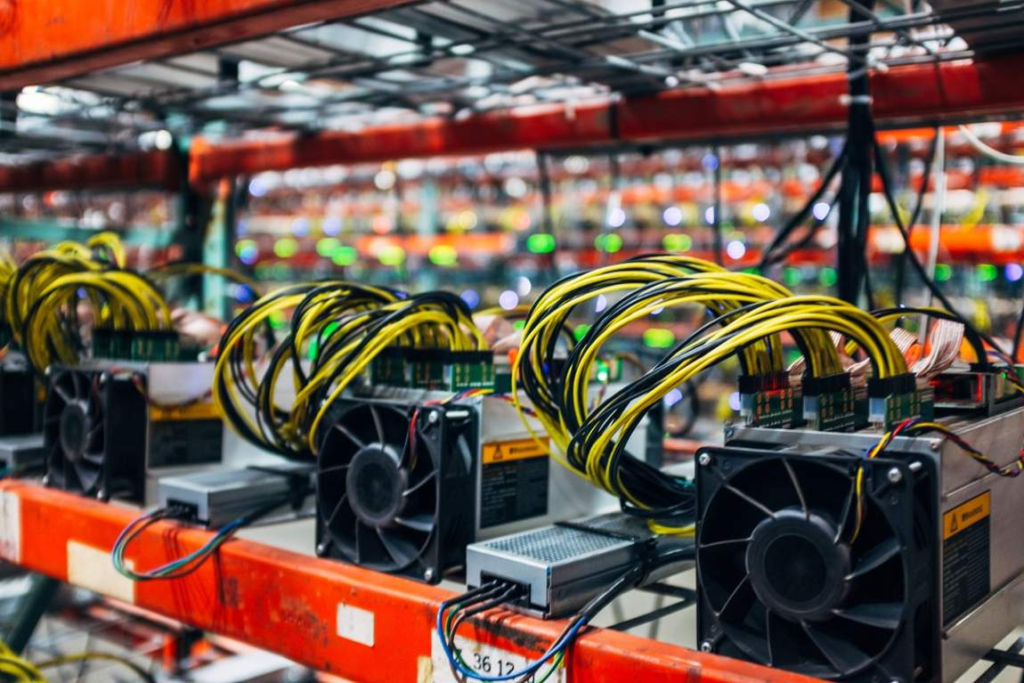
Mining systems rarely fail all at once. They collapse in sequence.
What looks like a sudden shutdown is usually the result of a chain reaction a series of small failures that build on each other until the entire system goes offline.
What a Chain Reaction Looks Like
Understanding this chain is critical. Because once it starts, it spreads fast.
A typical mining shutdown doesn’t begin with total failure.
It begins with something minor:
- A temperature spike
- A power fluctuation
- A cooling imbalance
At first, only one part of the system is affected.
But that’s enough to trigger the next problem.
Step 1: Initial Instability
Every chain reaction starts with a weak point.
Common triggers:
- Unstable voltage
- Blocked airflow
- Overloaded circuit
- Fan or cooling inefficiency
This creates localized stress inside one machine or section.
At this stage:
- The system is still running
- The issue is often unnoticed
Step 2: Performance Degradation
As the issue continues:
- Temperatures rise
- Efficiency drops
- Error rates increase
The affected machine begins to:
- Underperform
- Consume more power
- Operate outside optimal conditions
This is where performance starts to drift from expected output.
Step 3: First Failure Point
Eventually, one unit reaches its limit.
This leads to:
- Automatic shutdown
- Thermal protection trigger
- Power trip
Now the system is no longer stable.
But the real problem begins here.
- Step 4: Load Redistribution
When one machine goes offline:
- Electrical load shifts to other machines
- Cooling dynamics change
- Airflow patterns are disrupted
Remaining machines now operate under:
- Increased stress
- Altered conditions
This creates new instability points.
Step 5: Cascading Failures
As pressure increases on the system:
- Additional machines begin to overheat
- Voltage inconsistencies spread
- More shutdowns occur
Each failure amplifies the next.
This is the cascade phase:
- Small issue → multiple failures → system-wide instability
Step 6: Full System Shutdown
Eventually:
- Too many machines are affected
- Power systems trip
- Cooling systems fail to compensate
The entire mining setup goes offline.
What started as a small issue becomes:
Complete operational failure
Why Chain Reactions Spread So Fast
Mining systems are interconnected.
They share:
- Power infrastructure
- Cooling environment
- Physical space
- Load distribution
Because of this, a problem in one area doesn’t stay isolated.
It transfers across the system.
The Hidden Risk: Delay in Detection
One of the biggest challenges is timing.
Chain reactions develop:
- Gradually at first
- Rapidly at the end
By the time operators notice:
- Multiple failures have already occurred
- Recovery becomes more complex
How to Prevent Chain Reactions
Preventing shutdowns is not about reacting—it’s about designing stability.
1. Eliminate Single Points of Failure
Avoid dependencies where one issue can impact multiple systems
2. Maintain Power Stability
Ensure consistent voltage and balanced load distribution
3. Optimize Cooling Systems
Control airflow, temperature, and heat removal
4. Monitor Performance in Real Time
Track efficiency, temperature, and uptime continuously
5. Standardize Infrastructure
Use consistent hardware and setup design across systems
The Role of System Design
Chain reactions don’t happen in well-designed systems.
They happen in:
- Unbalanced setups
- Poorly planned infrastructure
- Rapid, unstructured scaling
A strong system:
- Contains failures
- Prevents spread
- Maintains stability under stress
Impact on Profitability
Full shutdowns don’t just affect uptime.
They cause:
- Lost mining revenue
- Recovery delays
- Increased maintenance cost
- Hardware stress
Even a short system-wide shutdown can have a significant financial impact.
Final Insight
Mining failures are rarely isolated events.
They are sequences.
A single issue, if ignored, becomes a system-wide problem.
The difference between stable operations and sudden shutdowns comes down to one thing:
How well your system handles small problems before they grow.
Conclusion
The chain reaction that causes full mining shutdowns is not sudden—it is built over time.
Small instabilities:
- Spread through shared systems
- Increase pressure across machines
- Lead to cascading failures
Preventing this requires:
- Strong infrastructure
- Continuous monitoring
- Controlled system design
Because in mining, stability is not just about avoiding failure. It’s about stopping problems before they spread.