





































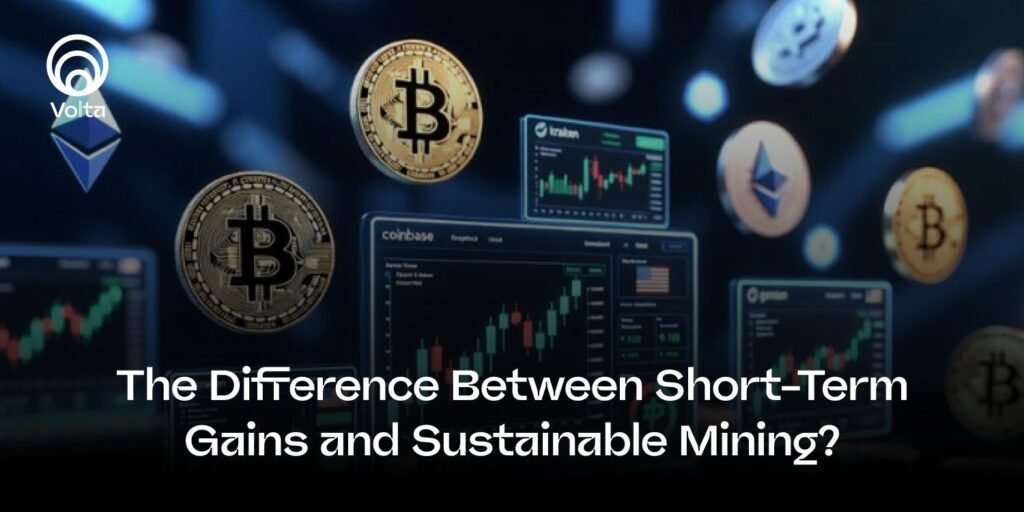

Many mining operations look profitable in the beginning. Strong daily revenue, rising coin prices, and high short-term returns can create the impression of a successful mining setup.
But in modern mining, short-term gains and long-term sustainability are completely different things.
A setup built only for immediate output often struggles with:
- Rising operational costs
- Thermal inefficiency
- Hardware degradation
- Infrastructure instability
- Long-term profitability decline
Sustainable mining focuses on something different:
Maintaining efficiency and profitability over time.
Why Short-Term Mining Gains Can Be Misleading
Mining profitability changes constantly.
Factors such as:
- Market volatility
- Mining difficulty
- Electricity pricing
- Network competition
can shift profitability rapidly.
This means short-term revenue numbers rarely reflect long-term operational performance.
Many miners make decisions based on:
- Temporary market hype
- Viral earnings screenshots
- Peak profitability periods
without evaluating whether the system can remain efficient months later.
What Defines Short-Term Mining Strategy
Short-term mining strategies usually focus on:
- Maximum immediate output
- Rapid scaling
- Aggressive expansion
- Chasing temporary profitability spikes
While this can generate quick returns during strong market conditions, it often ignores:
- Infrastructure limitations
- Cooling efficiency
- Operational sustainability
- Long-term system stability
As mining conditions change, these weaknesses become expensive.
What Sustainable Mining Actually Means
Sustainable mining focuses on:
- Stable efficiency
- Controlled operational cost
- Long-term infrastructure planning
- Predictable system performance
The goal is not just generating revenue today. The goal is maintaining profitable operations consistently through changing market conditions.
Efficiency Is the Core of Sustainable Mining
Efficiency determines:
- Energy waste
- Operating cost
- Cooling demand
- Infrastructure pressure
A mining setup that consumes excessive power may appear profitable during strong market periods but quickly loses stability when margins tighten.
Sustainable operations prioritize:
- Optimized energy usage
- Controlled thermal output
- Long-term efficiency retention
because these factors protect profitability during both strong and weak market cycles.
Why Infrastructure Matters More Over Time
Many mining setups fail because infrastructure was never designed for long-term operation.
Poor infrastructure creates:
- Thermal imbalance
- Unstable power delivery
- Cooling inefficiency
- Increased downtime
Short-term setups often overlook these issues because early profitability hides operational weaknesses.
Sustainable mining operations are built around:
- Proper airflow
- Stable electrical systems
- Cooling architecture
- Environmental consistency
before scaling hardware.
The Role of Thermal Stability
Heat is one of the biggest long-term threats to mining efficiency.
Poor thermal management causes:
- Higher power consumption
- Reduced hardware lifespan
- Efficiency degradation
- Greater maintenance cost
Sustainable mining farms invest heavily in:
- Airflow optimization
- Cooling systems
- Thermal monitoring
- Controlled environments
because stable temperatures protect long-term operational performance.
Why Uptime Matters More Than Peak Performance
Many miners focus on:
- Maximum hashrate
- Benchmark numbers
- Short-term output spikes
Professional operations focus on:
- Continuous uptime
- Predictable efficiency
- Stable long-duration performance
A machine producing slightly lower output but maintaining stable uptime often generates better long-term ROI than unstable high-performance setups.
The Financial Difference Between Short-Term and Sustainable Mining
Short-term mining strategies often create:
- Higher operational stress
- Faster infrastructure wear
- Greater maintenance cost
- Unstable profit margins
Sustainable mining focuses on reducing operational waste.
This creates:
- Better long-term profitability
- Lower infrastructure strain
- More predictable scaling opportunities
- Greater resilience during market downturns
Why Professional Mining Farms Think Differently
Industrial mining farms rarely chase short-term hype.
Instead, they prioritize:
- Operational consistency
- Infrastructure efficiency
- Long-term cost control
- Stable thermal behavior
They understand that mining success is built through system optimization rather than emotional expansion.
The Shift Happening in Modern Mining
Mining is evolving from:
- Raw hardware competition
into:
- Infrastructure-driven efficiency management
The most successful operations now resemble:
- Data centers
- Engineered compute environments
- Long-term operational systems
This shift rewards:
- Stability
- Efficiency
- Environmental control
- Infrastructure planning
more than temporary performance spikes.
The Hidden Risk of Chasing Short-Term Gains
Short-term thinking often leads to:
- Overpaying for hardware
- Expanding without infrastructure readiness
- Ignoring thermal limitations
- Underestimating operating cost
These problems usually appear slowly rather than immediately.
Over time, they reduce:
- Efficiency
- Profitability
- Scalability
- Operational stability
Why Sustainable Mining Wins Long Term
Sustainable mining is built around one principle:
Protect efficiency over time.
Operations that maintain:
- Stable cooling
- Controlled energy usage
- Predictable uptime
- Strong infrastructure
usually outperform aggressive short-term setups across long mining cycles.
Final Verdict
The difference between short-term gains and sustainable mining comes down to operational discipline.
Short-term mining focuses on immediate output.
Sustainable mining focuses on:
- Long-term efficiency
- Infrastructure quality
- Stable operational performance
- Controlled cost management
The mining farms that survive market volatility are rarely the ones chasing the fastest gains.
They are the ones building the most stable systems. Because in modern mining: Long-term profitability is created through sustainability, not temporary momentum.