






































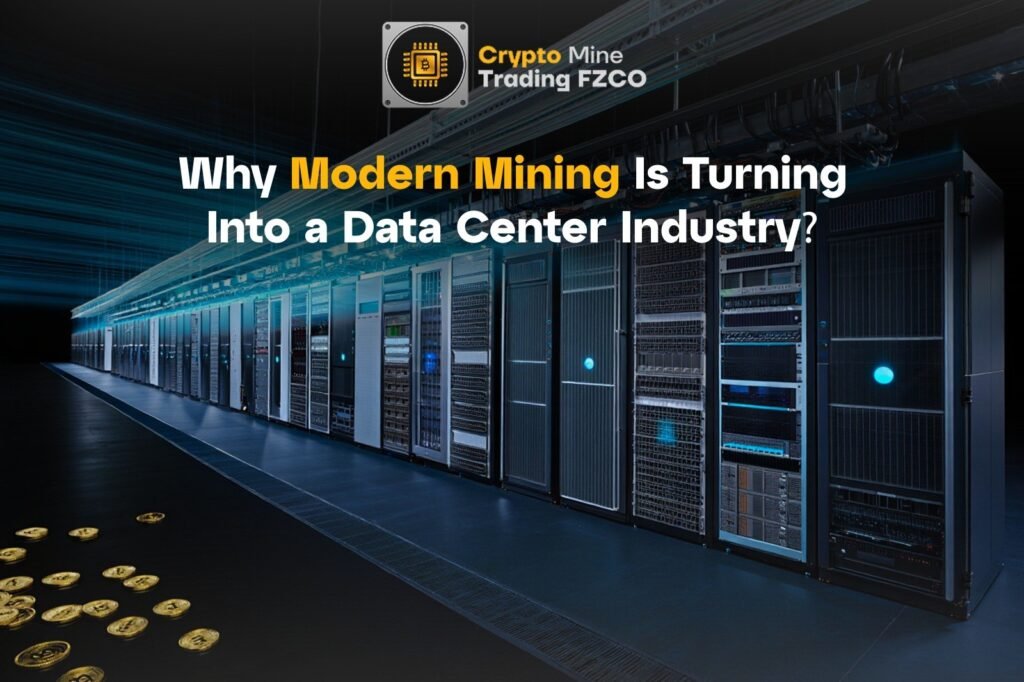
The mining industry has changed dramatically over the past few years. What once started as simple hardware setups running in homes or small warehouses has evolved into a highly engineered infrastructure business. In 2026, modern mining increasingly resembles the structure and operational standards of enterprise data centers. This shift is transforming how mining farms are designed, operated, and scaled.
The future of mining is no longer defined only by hardware performance. It is now shaped by infrastructure intelligence, cooling efficiency, operational stability, and high-density compute management.
Mining Has Evolved Beyond Hardware Ownership
Earlier mining environments focused mainly on machine quantity and raw hashrate. Miners competed by adding more ASICs as quickly as possible. But as mining difficulty increased and operational margins tightened, infrastructure weaknesses became more visible.
Large-scale mining operations discovered that profitability depends heavily on:
- Cooling efficiency
- Environmental stability
- Power management
- Uptime consistency
- Operational scalability
This is the same foundation that drives modern data center operations.
Why Modern ASICs Behave Like High-Density Compute Systems
Today’s ASIC miners are extremely powerful and operate continuously under industrial load. These systems generate enormous heat and consume significant electrical power.
Without proper infrastructure, mining farms face:
- Thermal instability
- Power inefficiency
- Operational interruptions
- Reduced hardware lifespan
This creates infrastructure demands very similar to enterprise compute facilities and AI data centers.
Modern mining environments now require:
- Structured airflow
- Precision cooling
- Stable power delivery
- Environmental control
- Continuous monitoring
because mining has effectively become a high-density computing industry.
Cooling Infrastructure Is Becoming a Core Priority
One of the biggest similarities between mining farms and data centers is thermal management.
Professional mining farms now invest heavily in:
- Hydro cooling systems
- Airflow engineering
- Thermal isolation zones
- Environmental automation
- Precision cooling architecture
because stable thermal conditions directly affect operational efficiency.
Traditional mining setups often treated cooling as secondary infrastructure. Modern industrial mining treats cooling as a core operational system.
This mirrors how enterprise data centers manage high-performance compute environments.
Power Stability Is Critical in Modern Mining
Data centers are built around stable electrical systems because uptime is essential. Mining operations now face the same requirement.
Industrial mining farms increasingly depend on:
- Redundant power systems
- Load balancing
- Predictable voltage distribution
- Infrastructure monitoring
because unstable power creates:
- Downtime risk
- Hardware stress
- Efficiency loss
- Infrastructure instability
Mining farms are becoming power-managed environments similar to enterprise compute facilities.
Why Environmental Control Matters
Modern data centers carefully regulate environmental conditions to protect hardware performance. Industrial mining farms now do the same.
Professional mining facilities monitor:
- Temperature consistency
- Humidity levels
- Air quality
- Dust exposure
- Heat movement
Controlled environments help maintain:
- Stable uptime
- Better ASIC efficiency
- Reduced operational stress
- Long-term hardware reliability
This level of environmental precision was uncommon in earlier mining generations.
Mining Farms Are Becoming Infrastructure-Driven
Modern mining profitability increasingly depends on infrastructure quality rather than simply hardware quantity.
Professional operators now focus heavily on:
- Operational consistency
- Thermal efficiency
- System scalability
- Environmental optimization
- Infrastructure intelligence
This infrastructure-first mindset closely resembles enterprise data center strategy.
The strongest mining operations are no longer simply buying more machines. They are building optimized compute ecosystems.
Scalability Requires Data Center Thinking
As mining farms expand, infrastructure complexity increases rapidly.
Without proper design, scaling creates:
- Cooling bottlenecks
- Power overload
- Environmental instability
- Reduced efficiency
Data center architecture solves these problems through:
- Structured deployment planning
- Cooling separation
- Rack optimization
- Predictable airflow engineering
Industrial mining farms increasingly adopt these same operational principles.
Monitoring Systems Are Becoming Essential
Modern mining facilities rely heavily on real-time infrastructure monitoring.
Professional operations track:
- Thermal behavior
- Hardware efficiency
- Power consumption
- Environmental stability
- Cooling performance
This level of operational intelligence is directly inspired by enterprise data center management.
Continuous monitoring allows mining farms to identify hidden inefficiencies before they become major operational failures.
Why AI Infrastructure Is Influencing Mining Design
The rapid growth of AI infrastructure is also influencing mining architecture. AI data centers and industrial mining farms share several infrastructure requirements:
- High-density compute environments
- Advanced cooling systems
- Stable electrical infrastructure
- Environmental control
- Continuous operational uptime
As GPU and AI infrastructure evolve, mining facilities increasingly adopt similar design standards.
Operational Efficiency Is Replacing Aggressive Expansion
Earlier mining strategies often prioritized rapid expansion regardless of infrastructure readiness. Modern mining is shifting toward:
- Controlled scalability
- Infrastructure balance
- Predictable efficiency
- Long-term sustainability
This mirrors how professional data centers prioritize operational stability over uncontrolled growth.
The mining industry is becoming more mature and infrastructure-focused.
Why Uptime Is More Valuable Than Peak Performance
Enterprise data centers prioritize uptime because operational consistency creates long-term value. Modern mining follows the same principle.
Professional mining farms increasingly focus on:
- Stable operational environments
- Predictable system behavior
- Reduced downtime
- Long-term efficiency retention
because continuous performance usually generates stronger profitability than unstable high-output setups.
The Future of Mining Infrastructure
Future mining facilities will likely continue evolving toward:
- AI-driven environmental automation
- Precision thermal engineering
- Smarter power optimization
- Predictive infrastructure monitoring
- Sustainable cooling systems
Mining farms will increasingly function as advanced compute facilities rather than traditional hardware warehouses.
Final Verdict
Modern mining is turning into a data center industry because profitability now depends heavily on infrastructure quality, cooling efficiency, operational stability, and environmental control. Industrial mining farms increasingly operate like high-density compute environments designed for continuous performance under heavy load. In 2026, successful mining operations are no longer be built only around ASIC hardware. They are built around intelligent infrastructure systems capable of sustaining efficient, scalable, and reliable long-term operation.