






































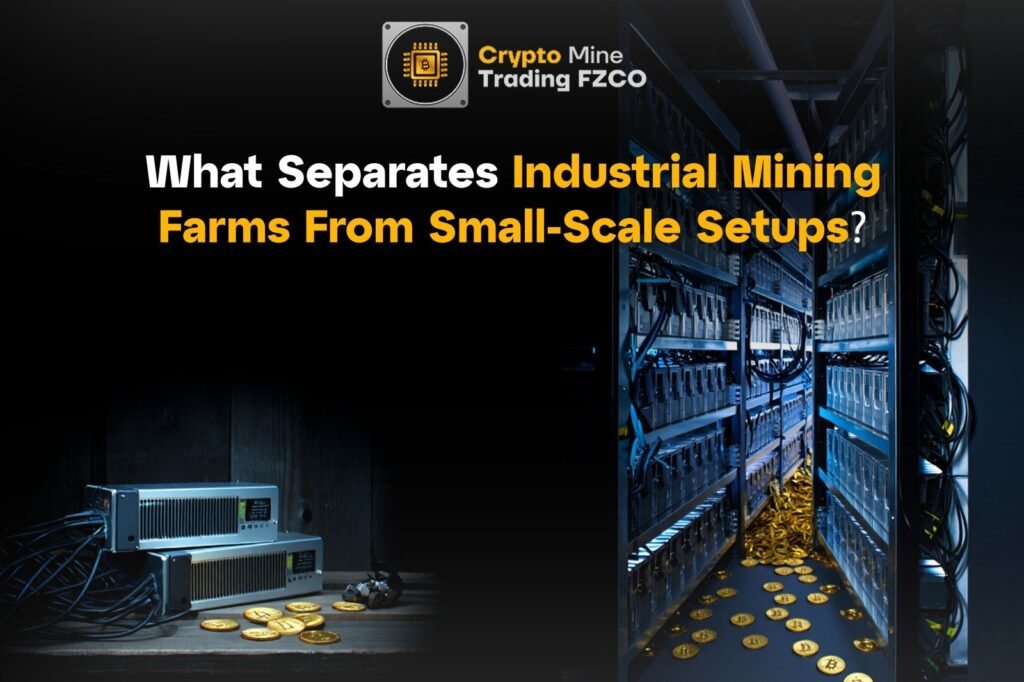
The mining industry has evolved far beyond simple home-based ASIC setups. In 2026, industrial mining farms operate more like high-density compute facilities than traditional mining rooms. While small-scale mining setups still exist, the gap between industrial operations and basic mining environments continues growing rapidly. The difference is no longer just about machine count. It is about infrastructure, operational efficiency, environmental control, and long-term scalability.
Mining Has Become an Infrastructure Business
Earlier mining setups focused mainly on hardware ownership. A few ASIC miners running inside a small room could generate meaningful returns during lower competition periods. But modern mining environments are significantly more competitive. Industrial mining farms now prioritize:
- Infrastructure engineering
- Thermal management
- Power stability
- Environmental optimization
- Operational scalability
This shift has transformed mining into a highly engineered operational industry.
The Difference Starts With Infrastructure
Small-scale setups often rely on limited infrastructure. Many operate using:
- Residential electrical systems
- Basic airflow
- Minimal cooling optimization
- Uncontrolled environments
Industrial mining farms, however, are designed specifically for continuous high-load operation. Professional facilities use:
- Industrial-grade power systems
- Precision cooling architecture
- Structured airflow engineering
- Environmental monitoring systems
because stable infrastructure directly affects mining profitability.
Why Cooling Defines Industrial Mining
One of the biggest differences between industrial farms and smaller setups is cooling efficiency. Small-scale setups often struggle with:
- Heat buildup
- Airflow imbalance
- Thermal instability
- Environmental inconsistency
Industrial mining farms invest heavily in:
- Hydro cooling
- Thermal zoning
- Heat isolation systems
- Advanced airflow management
because efficient thermal control protects long-term ASIC performance.
Professional operations understand that cooling is not just environmental support. It is a profitability system.
Power Stability Creates Operational Reliability
Industrial mining farms operate under massive continuous electrical load. This requires infrastructure capable of handling:
- Stable voltage distribution
- Load balancing
- Redundant systems
- High-density power delivery
Small-scale setups often depend on residential or lightly optimized electrical systems that may struggle under sustained operational pressure.
Professional mining farms prioritize electrical consistency because unstable power creates operational risk, downtime, and efficiency loss.
Environmental Control Is a Major Advantage
Industrial facilities maintain highly controlled operating environments. These systems regulate:
- Temperature
- Humidity
- Dust exposure
- Airflow consistency
- Heat movement
Small-scale setups usually operate in less predictable environments where external conditions can impact mining efficiency significantly.
Controlled environments allow industrial mining farms to maintain stronger uptime and more stable performance over long operational periods.
Scalability Separates Professional Operations
Small mining setups often become difficult to scale efficiently. Adding more ASICs without infrastructure planning creates:
- Cooling bottlenecks
- Power strain
- Thermal imbalance
- Rising operational instability
Industrial mining farms are built around scalable infrastructure systems designed to support future expansion while maintaining operational consistency.
This allows professional operations to grow without sacrificing efficiency.
Why Monitoring Systems Matter
Modern industrial mining farms rely heavily on real-time monitoring systems that track:
- Thermal behavior
- Power usage
- Hardware efficiency
- Environmental conditions
- Operational stability
This level of infrastructure intelligence allows operators to identify inefficiencies before they become serious operational problems.
Small-scale setups often rely on manual observation with limited system monitoring.
Maintenance Efficiency Is Different at Scale
Industrial mining facilities are designed to reduce maintenance complexity through:
- Structured rack systems
- Organized cooling layouts
- Predictable airflow paths
- Controlled hardware deployment
Professional operations focus on minimizing downtime because even short interruptions create significant financial impact at scale.
Small setups often experience less predictable maintenance environments due to infrastructure limitations.
Why Operational Discipline Matters
Industrial mining farms operate with strict operational discipline. Professional operators focus on:
- Long-term infrastructure stability
- Efficiency optimization
- Controlled scaling
- Predictable performance
Small-scale setups often prioritize short-term profitability or rapid expansion without fully optimizing infrastructure systems.
Professional mining environments succeed because they treat mining as an operational science rather than simply hardware ownership.
Industrial Mining Resembles Modern Data Centers
Today’s industrial mining farms increasingly resemble enterprise data centers. They use:
- Structured cooling systems
- Thermal engineering
- Precision airflow management
- Environmental automation
- High-density compute architecture
This evolution reflects how modern mining has become deeply connected to infrastructure engineering and operational intelligence.
Why Efficiency Matters More Than Hardware Quantity
Small-scale miners often focus heavily on machine count or peak hashrate. Industrial operations increasingly focus on:
- Efficiency retention
- Uptime consistency
- Thermal optimization
- Infrastructure sustainability
because long-term profitability depends on maintaining stable performance under continuous industrial load.
A smaller but highly optimized operation can often outperform larger unstable setups over time.
The Hidden Advantage of Industrial Operations
Industrial mining farms benefit from:
- Better operational consistency
- Reduced environmental stress
- Lower efficiency loss
- Improved scalability
- Stronger infrastructure resilience
These advantages compound over long operational cycles, creating more predictable profitability.
This is why industrial operations increasingly dominate modern mining markets.
The Future of Industrial Mining
Future industrial mining facilities will likely become even more advanced through:
- AI-driven infrastructure monitoring
- Automated thermal optimization
- Smarter energy management
- Precision environmental control
- Sustainable cooling systems
As mining competition intensifies, infrastructure intelligence will continue becoming one of the biggest operational advantages.
Final Verdict
What separates industrial mining farms from small-scale setups is not simply hardware quantity. The real difference lies in infrastructure quality, thermal management, power stability, operational discipline, and scalability. Professional mining farms operate as engineered compute environments designed for continuous efficiency and long-term performance. In modern mining, stable infrastructure and controlled environments create far greater competitive advantage than hardware count alone.