






































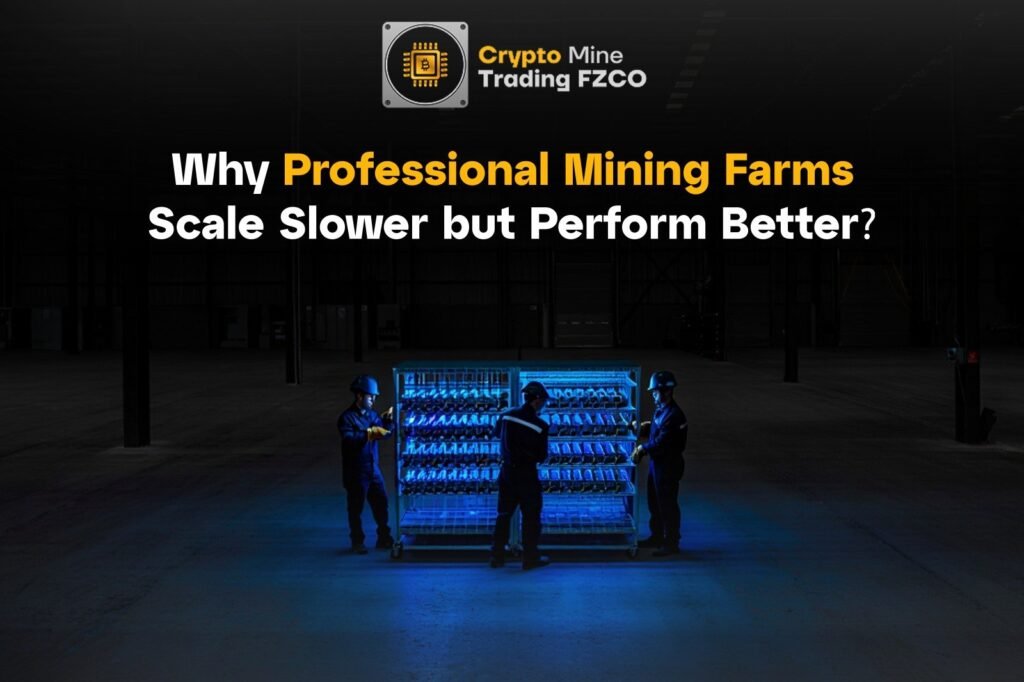

In modern mining, bigger does not always mean better. Many new operators assume rapid expansion automatically leads to stronger profitability, but professional mining farms often take the opposite approach. Instead of scaling aggressively, experienced operators focus on controlled growth, infrastructure readiness, and operational stability. In 2026, some of the most successful mining farms scale slower because stable systems consistently outperform unstable expansion.
The mining industry is evolving into a highly engineered infrastructure business where operational consistency matters more than rapid hardware accumulation.
The Problem With Aggressive Mining Expansion
Rapid mining growth usually focuses heavily on:
- Adding more ASICs quickly
- Increasing total hashrate
- Expanding machine count
- Maximizing short-term output
While this strategy may temporarily increase production, it often creates infrastructure pressure that weakens long-term profitability.
Mining farms that scale too quickly commonly face:
- Cooling bottlenecks
- Power instability
- Airflow imbalance
- Environmental stress
- Rising maintenance issues
Professional operators understand that uncontrolled growth often creates operational inefficiency.
Why Infrastructure Must Scale First
Experienced mining farms prioritize infrastructure before hardware expansion. They carefully evaluate:
- Cooling capacity
- Power distribution
- Environmental stability
- Rack organization
- Airflow management
before increasing machine density.
This infrastructure-first approach allows operations to maintain:
- Stable uptime
- Better efficiency retention
- Lower operational stress
- Predictable scalability
Professional mining farms know that hardware performs only as well as the environment supporting it.
Cooling Stability Is More Important Than Fast Growth
Modern ASIC miners generate significant heat under continuous industrial load. Adding more machines without proper thermal planning creates:
- Hotspots
- Heat recirculation
- Thermal throttling
- Rising energy waste
Professional operations scale cooling systems carefully to maintain environmental balance.
This often means slower expansion, but it creates stronger long-term mining performance.
Stable thermal conditions help ASICs maintain:
- Consistent efficiency
- Reduced hardware wear
- Better uptime
- Longer operational lifespan
Why Controlled Growth Improves Operational Efficiency
Professional mining farms understand that operational consistency creates more predictable profitability than unstable high-output environments.
Controlled scaling allows operators to:
- Monitor infrastructure performance
- Optimize system balance
- Identify inefficiencies early
- Prevent operational overload
This disciplined approach reduces hidden operational costs that often appear inside rapidly expanded mining facilities.
Power Stability Matters at Scale
As mining farms grow, electrical infrastructure becomes increasingly complex.
Aggressive expansion can create:
- Voltage fluctuation
- Distribution imbalance
- System overload
- Downtime risk
Professional mining farms scale electrical systems carefully using:
- Load balancing
- Redundant power architecture
- Structured distribution systems
- Infrastructure monitoring
because stable power delivery directly protects operational performance.
Professional Mining Is Built Around Predictability
Large industrial mining farms operate continuously under heavy load. Predictable performance matters far more than occasional output spikes.
Professional operators prioritize:
- Stable uptime
- Controlled environments
- Thermal consistency
- Infrastructure resilience
because consistent operational efficiency produces stronger long-term ROI.
Mining profitability increasingly depends on infrastructure discipline rather than aggressive hardware accumulation.
Why Monitoring Systems Influence Scaling Decisions
Professional mining farms rely heavily on infrastructure monitoring before expanding operations.
Operators continuously analyze:
- Heat distribution
- Power usage
- Cooling performance
- Hardware efficiency
- Environmental stability
This data-driven approach allows mining farms to scale intelligently instead of reacting emotionally to short-term market conditions.
Infrastructure Problems Compound at Scale
Small operational inefficiencies become much more dangerous inside large mining environments.
Rapid uncontrolled scaling often amplifies:
- Airflow imbalance
- Heat concentration
- Energy waste
- Maintenance complexity
Professional operators avoid these risks by scaling gradually while maintaining environmental control.
This creates stronger infrastructure sustainability over long operational cycles.
Why Stable Uptime Outperforms Peak Output
Many mining farms focus heavily on maximizing immediate performance. However, unstable environments often experience:
- Frequent interruptions
- Thermal shutdowns
- Hardware stress
- Reduced efficiency retention
Professional operations focus on stable uptime because continuous performance usually creates stronger profitability than unstable aggressive output.
In modern mining, reliability has become a competitive advantage.
Mining Farms Are Becoming Infrastructure Businesses
Today’s professional mining facilities increasingly resemble high-density compute environments rather than simple hardware warehouses.
Modern operations focus heavily on:
- Cooling architecture
- Environmental engineering
- Power optimization
- Structured deployment planning
because infrastructure quality now determines operational performance.
This shift explains why experienced mining farms often expand more cautiously.
Why Slower Scaling Creates Better Long-Term ROI
Controlled growth helps mining farms:
- Protect hardware lifespan
- Reduce maintenance cost
- Improve energy efficiency
- Maintain operational consistency
- Avoid infrastructure overload
These advantages compound significantly over time.
Professional operators understand that sustainable profitability is built through infrastructure balance rather than aggressive expansion speed.
The Future of Mining Scalability
Future mining farms will likely continue emphasizing:
- Smart infrastructure planning
- AI-driven cooling optimization
- Predictive environmental management
- Controlled operational scaling
- Sustainable efficiency engineering
The industry is moving toward infrastructure intelligence rather than pure hardware competition.
Final Verdict
Professional mining farms scale slower because controlled growth creates stronger operational performance. Modern mining profitability depends heavily on cooling stability, infrastructure readiness, power management, and environmental consistency. Aggressive expansion often creates hidden inefficiencies that reduce long-term ROI. Professional operators prioritize stable systems, predictable performance, and sustainable scalability because operational discipline consistently outperforms uncontrolled growth in industrial mining.