ASIC vs GPU Mining: A Practical Comparison for 2026
Compare asic vs gpu mining for 2026. Discover key differences in efficiency, algorithm flexibility, resale value, and ROI with CryptoMine's expert guide.
CryptoMine Editorial · July 25, 2026 · 7 min read

The digital asset mining landscape in 2026 demands unprecedented operational precision. As network difficulties reach record highs and energy efficiency targets become tighter worldwide, hardware selection stands as the single most critical decision for institutional investors and boutique miners alike. When evaluating asic vs gpu mining, prospective operators must weigh distinct capital expenditure profiles, algorithm dependencies, and long-term asset liquidities.
Navigating this choice requires looking beyond initial hash rate metrics to analyze full lifecycle costs, thermodynamic footprints, and hardware repurposing capabilities. Whether you are building an industrial data center in the Middle East or scaling a specialized mining farm, understanding the fundamental divergence between Application-Specific Integrated Circuits (ASICs) and Graphics Processing Units (GPUs) is essential for maximizing risk-adjusted returns.
Understanding ASIC vs GPU Mining: Architecture and Core Differences
To grasp the operational dynamics of modern cryptocurrency mining, one must first analyze the fundamental hardware architectures that drive computation.
Application-Specific Integrated Circuits (ASICs)
An ASIC is an integrated circuit customized for a precise computing task rather than general-purpose processing. In the context of digital asset mining, an ASIC silicon die is hardwired to execute a single cryptographic hashing algorithm, such as SHA-256 for Bitcoin or Scrypt for Litecoin and Dogecoin.
Because every transistor on an ASIC die is dedicated exclusively to the mathematical operations required by its target algorithm, these machines achieve unmatched computational throughput and energy efficiency. High-density units like the Bitmain Antminer S21 demonstrate how specialized silicon delivers extreme efficiency metrics, measured in Joules per Terahash (J/TH). However, this specialization comes at a strict cost: an ASIC cannot mine algorithms outside its factory configuration, nor can it perform general computing tasks like artificial intelligence inference or graphic rendering.
Graphics Processing Units (GPUs)
In contrast, GPUs are highly flexible, massively parallel processors designed to handle millions of simultaneous mathematical operations. Originally developed for 3D graphics rendering, modern GPUs feature specialized compute cores (such as CUDA and Tensor cores) paired with high-bandwidth memory (VRAM).
This programmable architecture allows GPUs to dynamically switch between hundreds of different mining algorithms, from KHeavyHash to memory-intensive GPU-friendly proof-of-work protocols. Top-tier consumer and enterprise hardware, such as the NVIDIA RTX 5090, provide broad versatility. While GPUs yield lower hashing efficiency per watt on fixed algorithms compared to dedicated ASICs, their adaptability protects operators against algorithm shifts and network hard forks.
Key Performance Factors: Efficiency, Versatility, and Cost
When conducting a feasibility study for a new installation, enterprise operators must analyze four core operational metrics.
1. Hash Rate Efficiency and Power Consumption
- ASICs: Focus on sheer volume and raw algorithm efficiency. Industrial ASICs operate at power draws ranging between 3,000W and 5,500W per unit, generating immense heat but delivering unmatched hashes per watt for dominant coins.
- GPUs: Focus on energy flexibility and memory bandwidth performance. Individual cards consume between 150W and 450W, making them suitable for variable-density deployments and distributed rack systems.
2. Capital Expenditure (CapEx) and Setup Complexity
- ASICs: Turnkey deployments that combine hashboards, control boards, and specialized power supply units (PSUs) into a single chassis. Setup involves installing high-voltage electrical infrastructure (often 380V–480V three-phase power) and heavy-duty ventilation or immersion cooling tanks.
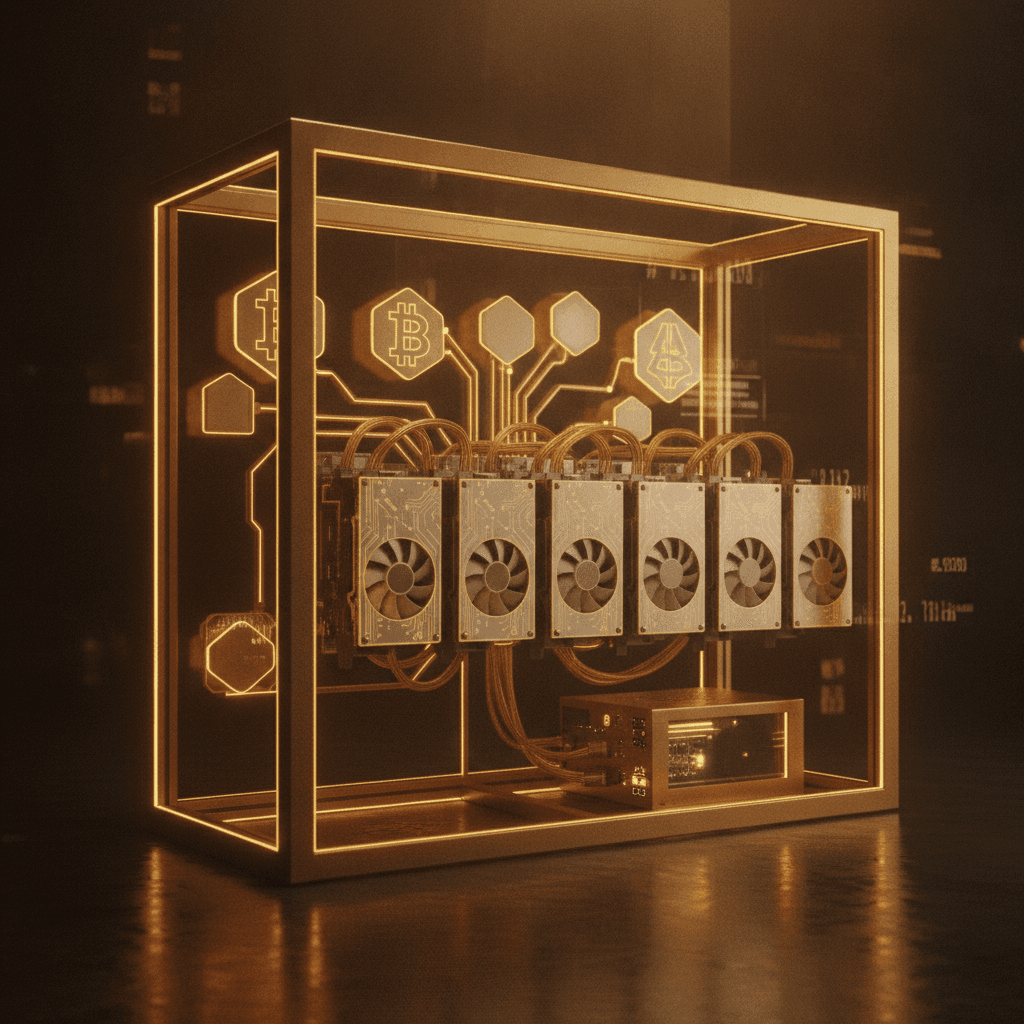
- GPUs: Require multi-component assembly, including specialized motherboards, riser cards, external power supplies, and high-airflow frames. Solutions like the engineered CryptoMine 8-GPU Mining Rig streamline this process by delivering pre-configured, industrial-grade chassis designed for high-density rack installation.
3. Operational Expenditure (OpEx) and Maintenance
- ASICs: Highly sensitive to power tariffs. Because ASICs cannot pivot to alternative tasks, profitability relies directly on securing low-cost electricity (ideally under $0.04–$0.06 per kWh).
- GPUs: Offer a higher threshold for electrical costs due to the ability to target higher-margin altcoins, mine low-difficulty emerging tokens, or transition compute power to AI workloads when coin profitability dips.
Residual Value, Hardware Lifespan, and AI Repurposing
One of the most stark contrasts between ASICs and GPUs lies in their financial depreciation profiles and secondary market liquidity.
ASIC Depreciation and E-Waste Risk
ASIC miners suffer from steep, steplike depreciation curves. When a new generation of semiconductor node technology enters the market (e.g., transitioning from 5nm to 3nm processes), older ASIC models experience rapid declines in efficiency ratios. Once an ASIC becomes unprofitable at a given electricity rate, its market value approaches scrap value because the hardware cannot perform any other functional duty.
GPU Utility in High-Performance Computing (HPC)
GPUs retain substantial residual value throughout their operational life. Because a high-end GPU is fundamentally an enterprise-grade compute processor, non-profitable mining equipment can be seamlessly repurposed into commercial compute clusters.
In 2026, the convergence of crypto infrastructure and AI cloud compute has accelerated. Mining operators utilizing enterprise server chassis, such as the Supermicro AS-4125GS GPU Server, can pivot their infrastructure from proof-of-work mining to AI model fine-tuning, rendering, and scientific simulation. Explore our full range of enterprise hardware in the CryptoMine Graphics Cards collection.
Which Mining Hardware Fits Your Operational Strategy?
To determine the optimal hardware architecture for your facility, consider the following decision criteria:
-
Choose ASIC Mining if:
- You have secured large-scale, low-cost power contracts (under $0.05/kWh) or direct stranded energy access.
- You intend to target established Tier-1 cryptocurrencies like Bitcoin (SHA-256) or Litecoin/Dogecoin (Scrypt).
- You have industrial infrastructure capable of handling extreme power density, noise levels (75–85 dB), and advanced thermal management (immersion or hydro-cooling).
- Your objective is maximum coin production per square meter of facility space.
-
Choose GPU Mining if:
- You seek operational flexibility across emerging proof-of-work protocols and algorithm changes.
- You operate in regions with moderate electricity costs where maximum efficiency can be supplemented by mining high-yield altcoins.
- You want to maintain a multi-use asset fleet capable of transitioning into AI compute, cloud rendering, or enterprise HPC hosting.
- You prefer lower noise profiles and modular power scalability.
Conclusion: Making the Right Investment Choice in ASIC vs GPU Mining
There is no universal winner in the asic vs gpu mining debate; the optimal decision hinges on your access to capital, power infrastructure, and risk tolerance. ASICs offer unmatched hash rate volume and efficiency for institutional operations anchored to primary networks like Bitcoin. GPUs provide crucial downside protection, operational agility, and high secondary market value through dual-utility in AI and high-performance computing.
At CryptoMine, we supply global mining operations, enterprise data centers, and institutional clients with premium mining rigs, bare-metal servers, and high-performance GPUs. Contact our technical advisory team today to design an optimized hardware deployment tailored to your power budget and financial targets.
FAQ
Is ASIC mining still more profitable than GPU mining in 2026? ASIC mining generally yields higher absolute revenue and lower cost-per-hash on mature networks like Bitcoin due to its supreme architectural efficiency. However, GPU mining can deliver higher short-term risk-adjusted returns by dynamically targeting newly launched or memory-bound proof-of-work tokens with lower network difficulty.
Can GPU mining rigs be easily repurposed for AI computational workloads? Yes, but repurposing requires proper infrastructure alignment. While the GPUs themselves are well-suited for AI inference and training, an enterprise AI setup typically demands higher PCIe lane bandwidth, expanded system RAM, and industrial server chassis rather than open-frame mining rigs.
What cooling infrastructure is required for ASICs compared to GPUs? ASICs generate concentrated, high-velocity heat streams and substantial operational noise, often requiring specialized air ducting, high-CFM industrial fans, or fluid immersion cooling systems. GPUs run cooler on an individual card basis and can be managed efficiently using standard data center HVAC or high-airflow multi-GPU rackmount server chassis.
How long is the typical operational lifespan of modern mining hardware? ASICs typically remain economically viable for 3 to 5 years before next-generation efficiency improvements make them obsolete at standard power rates. High-end GPUs maintain operational performance for 4 to 6 years, with ongoing residual value preserved by strong demand in the enterprise, creative, and AI processing markets.
CryptoMine Editorial
Hardware specialists at CryptoMine — helping B2B and mining buyers choose, configure and deploy the right kit.