H100 vs H200 vs B200: Choosing NVIDIA Data-Center GPUs in 2026
An enterprise evaluation of NVIDIA Hopper and Blackwell architectures to guide procurement leads and engineers in scaling AI infrastructure.
CryptoMine Editorial · July 27, 2026 · 6 min read
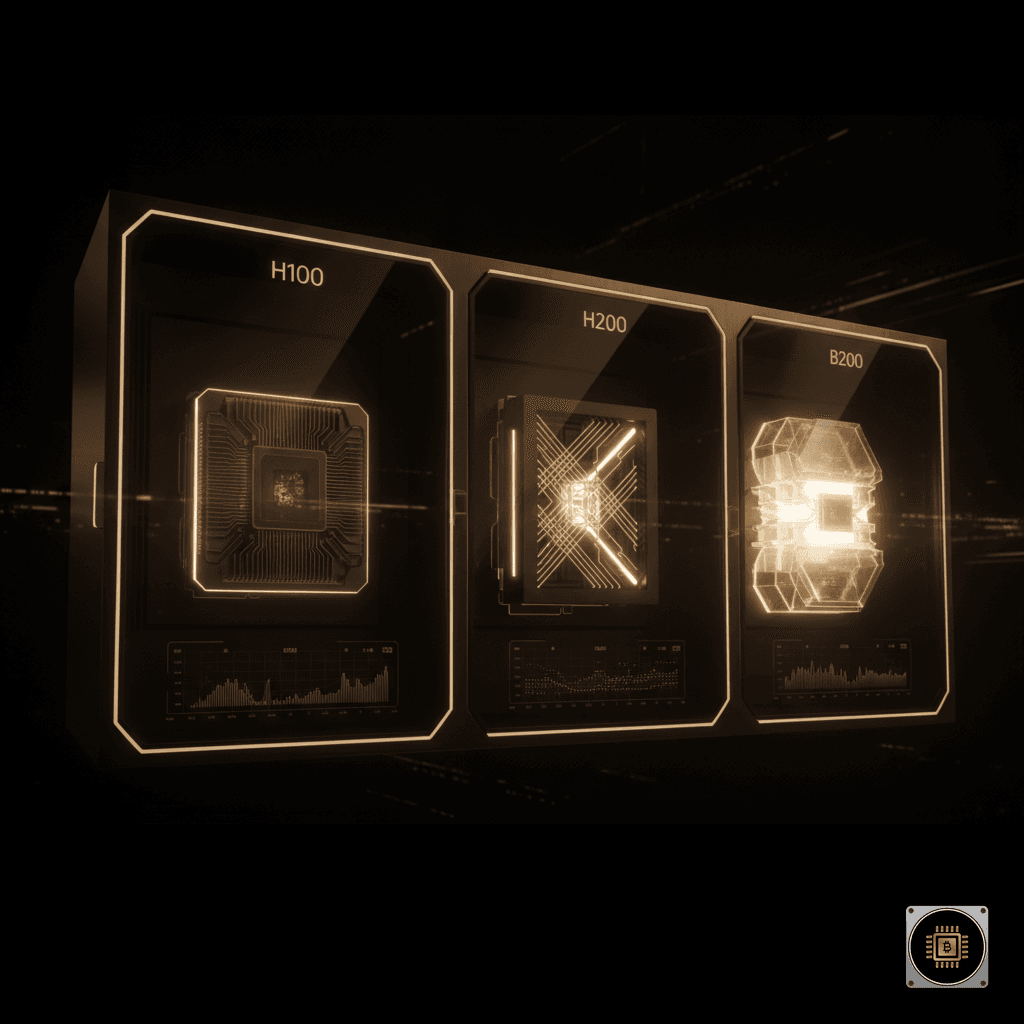
Deploying scalable artificial intelligence infrastructure requires precise alignment between hardware capabilities and workload demands. As enterprise foundation models expand in parameter count and inference traffic accelerates worldwide, selecting the optimal data-center accelerator has become a critical decision for procurement teams, machine learning engineers, and system architects. When comparing H100 vs H200 vs B200 accelerators, organization leadership must analyze raw compute throughput, high-bandwidth memory specifications, interconnect capabilities, power delivery, and overall total cost of ownership.
CryptoMine provides enterprise-grade AI hardware and fully integrated infrastructure solutions to data centers, research institutions, and enterprise clients globally. This guide evaluates the flagship NVIDIA compute architectures to help teams make informed capital expenditure decisions for high-performance computing and model deployment.
Architecture Overview: Hopper vs Blackwell
The landscape of data-center computing relies on two primary architectural generations: NVIDIA Hopper and NVIDIA Blackwell. Understanding the physical and microarchitectural distinctions between these generations is foundational to hardware selection.
The Hopper architecture, introduced with the NVIDIA H100, established a milestone in AI acceleration by introducing dedicated Transformer Engine hardware, enhanced FP8 precision matrix multiplication, and fifth-generation NVLink capabilities. Manufactured on a custom TSMC 4N process, the H100 was engineered to handle complex deep learning training and high-throughput inference.
Building upon the Hopper microarchitecture, the NVIDIA H200 retains the underlying compute silicon of the H100 while implementing a major memory subsystem upgrade. By adopting HBM3e high-bandwidth memory, the H200 addresses memory capacity and bandwidth constraints that frequently bottleneck massive language model inference without altering the core compute logic.
The Blackwell architecture represents a design shift with the introduction of the NVIDIA B200. Built utilizing a multi-chiplet die construction connected via a high-speed interposer, Blackwell doubles the footprint of high-density silicon. It introduces second-generation Transformer Engine hardware capable of native FP4 precision compute, dramatically expanding processing efficiency for generative AI workloads while maintaining accuracy through advanced scaling algorithms.
Memory Subsystem Capabilities and Bandwidth Analysis
In modern artificial intelligence workloads, particularly large language model inference and long-context transformer architectures, memory capacity and memory bandwidth often dictate performance limits more than raw compute capacity.
The NVIDIA H100 80GB features 80GB of HBM3 memory delivering up to 3.35 TB/s of memory bandwidth. While highly capable for parallel training clusters and medium-scale model serving, 80GB of VRAM can require multi-GPU tensor parallelism merely to fit large parameter sets into memory, increasing communication overhead across the interconnect.
To resolve these memory limits, the NVIDIA H200 increases VRAM capacity to 141GB of HBM3e memory, boosting bandwidth to 4.8 TB/s. This 76 percent increase in memory capacity and 43 percent increase in memory bandwidth allows large models, such as 70-billion parameter transformer architectures, to run on fewer physical devices. Consequently, organizations can reduce tensor-parallel overhead, lower latency, and significantly increase output token throughput per server node.
The NVIDIA B200 expands memory specifications further, incorporating up to 192GB of HBM3e memory with a memory bandwidth of up to 8 TB/s. This massive memory pipeline enables real-time generation and parameter caching for massive trillion-parameter models, allowing high-throughput concurrent inference streams that were previously unachievable on single-node configurations.
Performance Metrics and Precision Scalability
Evaluating processing capabilities across architectural generations requires analyzing floating-point performance at various precision levels.
Hopper GPUs introduced widespread deployment of FP8 precision, enabling substantial throughput gains over traditional FP16 and BF16 formats. The H100 delivers exceptional FP8 compute performance, while the H200 matches this compute density while sustaining higher utilization due to its enhanced memory feed.
Blackwell introduces native support for FP4 precision, effectively doubling the compute throughput compared to FP8 execution on equivalent silicon areas. For inference operations where FP4 quantization preserves acceptable model accuracy, the B200 provides up to a fourfold increase in training speed and multi-fold improvements in generation rates over Hopper equivalents. Additionally, improved NVLink interconnect speeds enable higher bandwidth scaling across multi-node clusters, mitigating communication bottlenecks during large-scale distributed training.
Power, Thermal Dissipation, and Server Integration
Deploying high-density accelerator clusters introduces strict power delivery and thermal management challenges in enterprise data centers.
The standard H100 and H200 modules are designed within thermal design power ratings ranging from 350W for PCIe form factors up to 700W for high-performance SXM modules. These thermal envelopes align with existing air-cooled and hybrid liquid-cooled data-center racks. Standard configurations can be integrated into high-density rackmount chassis such as the Supermicro AS-4125GS GPU Server or specialized platforms found in our enterprise server catalog.
In contrast, the B200 demands significantly expanded infrastructure capabilities. Higher TDP configurations reaching up to 1000W per module necessitate advanced thermal management solutions. While air cooling remains possible for certain configurations, multi-node Blackwell architectures increasingly require liquid-cooling infrastructure to maintain optimal operating temperatures and operational reliability.
H100 vs H200 vs B200: Workload Matching and TCO Analysis
Selecting between these GPU platforms requires balancing performance demands against capital expenditure and operational costs. Evaluating H100 vs H200 vs B200 options involves clear workload segmentation:
- Large-Scale Model Training: For multi-hundred-billion to trillion-parameter foundation models, the B200 provides superior efficiency. Its FP4 capabilities and ultra-fast memory bandwidth dramatically compress training times, offsetting higher hardware acquisition costs through reduced cluster runtimes and power efficiency per compute unit.
- Generative AI and LLM Inference: The H200 stands out as an optimal, highly cost-effective platform for running current-generation foundation models. The 141GB VRAM allocation permits hosting large parameter models without requiring expensive, sprawling server clusters, yielding lower TCO for enterprise inference APIs.
- Enterprise Fine-Tuning and HPC: The H100 remains a robust, readily available solution for medium-scale training, fine-tuning, computer vision, domain-specific HPC, and enterprise AI applications. Its established ecosystem and lower unit acquisition cost make it highly accessible for organizations establishing or expanding on-premise compute capacity.
Conclusion and Strategic Hardware Deployment
Choosing the ideal GPU architecture depends on specific model parameters, latency targets, power limits, and budgetary parameters. A thorough H100 vs H200 vs B200 comparison demonstrates that while the B200 defines the performance frontier for massive AI scaling, the H200 offers an outstanding balance for high-memory inference, and the H100 provides dependable, highly scalable compute power for everyday enterprise workloads.
At CryptoMine, we assist clients worldwide with sourcing, configuring, and deploying enterprise-grade AI infrastructure. Contact our engineering team to review system requirements, secure hardware allocation, and optimize your compute architecture.
FAQ
Which GPU is best suited for large language model inference? The NVIDIA H200 and B200 are exceptionally well-suited for large language model inference due to their high HBM3e memory capacities and bandwidth. The H200 with 141GB VRAM allows enterprise teams to serve 70-billion parameter models efficiently on fewer GPUs, while the B200 provides maximum token throughput for massive, multi-tenant AI applications using FP4 precision.
Can H100 and H200 GPUs be mixed within the same cluster node? While H100 and H200 GPUs share the same underlying Hopper microarchitecture, mixing different GPU models within a single NVLink domain or unified node is not recommended or supported for high-performance tensor-parallel operations. However, H100 and H200 nodes can operate side by side within the same network fabric for distinct cluster jobs.
What is the primary advantage of the B200 over Hopper architecture GPUs? The Blackwell B200 introduces a dual-chiplet architecture, native FP4 precision support via a second-generation Transformer Engine, up to 192GB of HBM3e VRAM, and up to 8 TB/s of memory bandwidth. These advances deliver significantly higher compute density and power efficiency for large-scale model training and real-time generation.
What power and cooling infrastructure is required for Blackwell B200 systems? High-density B200 modules can draw up to 1000W per GPU, requiring high-capacity power distribution units and advanced thermal management. While individual PCIe or standard server implementations may support air cooling, high-density SXM and multi-node Blackwell architectures generally require liquid cooling solutions to maintain optimal system stability.

CryptoMine Editorial
Hardware specialists at CryptoMine — helping businesses choose, configure and deploy AI servers, data-center GPUs and workstation hardware.