NVIDIA L40S vs L4: Right-Sizing GPUs for AI Inference
Selecting between high-density single-slot accelerators and full-height performance engines requires matching model scale to hardware specs.
CryptoMine Editorial · July 31, 2026 · 7 min read
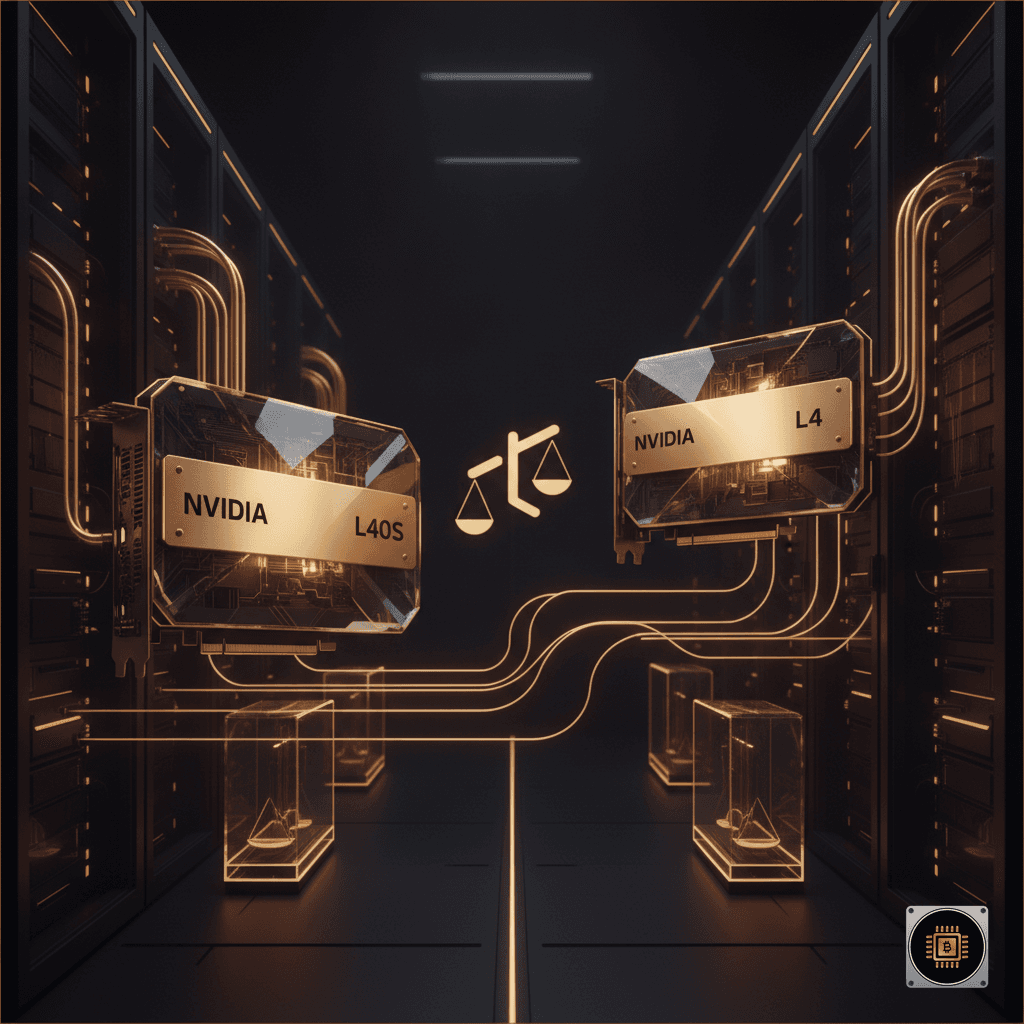
Deploying production AI models at enterprise scale requires a clear understanding of compute requirements, memory bandwidth, thermal budgets, and total cost of ownership. While large-scale training clusters dominate hardware headlines, the vast majority of ongoing operational expenditure centers on serving trained models efficiently to end users. Within the enterprise hardware ecosystem, two PCIe accelerators based on the NVIDIA Ada Lovelace architecture have emerged as standard choices for serving production workloads: the NVIDIA L40S and the NVIDIA L4. Deciding between them comes down to a fundamental engineering trade-off between raw compute throughput, VRAM capacity, and power density. Conducting a detailed L40S vs L4 inference assessment enables procurement teams, system architects, and machine learning engineers to right-size their server fleets without overprovisioning power or hardware capital.
Architectural Overview and Hardware Specifications
Both cards leverage the fourth-generation Tensor Cores and Transformer Engine inherent to the Ada Lovelace architecture. This provides native hardware acceleration for FP8 data types, dramatically reducing memory footprint and boosting execution speeds for deep learning models relative to legacy FP16 or FP32 formats. However, their underlying physical design and target environments differ significantly.
The NVIDIA L40S is built as a full-height, full-length, dual-slot accelerator designed for maximum compute density in data center environments. Packing 48GB of GDDR6 memory with ECC and operating at a maximum thermal design power of 350W, the card provides immense execution resources for demanding workloads. By contrast, the NVIDIA L4 is engineered as a low-profile, single-slot PCIe card drawing just 72W of power. With 24GB of GDDR6 memory, the L4 is designed to fit into almost any standard enterprise server, edge node, or high-density rack chassis without requiring specialized power supplies or advanced liquid cooling systems.
Key architectural metrics highlight these hardware distinctions:
- Compute and Tensor Performance: The L40S features 142 RT Cores and 568 Tensor Cores, delivering over 733 TFLOPS of FP8 Tensor performance without structural sparsity, and up to 1,466 TFLOPS with sparsity. The L4 features 58 RT Cores and 242 Tensor Cores, generating 242 TFLOPS of FP8 performance (485 TFLOPS with sparsity).
- Memory Capacity and Bandwidth: The 48GB VRAM configuration on the L40S delivers up to 864 GB/s of memory bandwidth across a 384-bit bus. The 24GB VRAM on the L4 provides 300 GB/s across a 192-bit bus.
- Form Factor and Power: The 350W TDP of the L40S requires active air cooling or optimized data center airflow within enterprise platforms such as the Dell PowerEdge R760 or HPE ProLiant DL380 Gen11. The 72W L4 draws power directly from the PCIe slot, enabling dense multi-GPU deployments even in standard 1U or 2U servers.
Evaluating Performance for L40S vs L4 Inference Workloads
Selecting the correct accelerator depends directly on the parameters of the models being served, the target request latency, and expected concurrent request volumes. Different deep learning disciplines impose distinct bottlenecks on system hardware.
Large Language Models and Generative AI
Large language models present severe memory bandwidth and VRAM capacity challenges. Running models like Llama 3 or Mistral with low latency requires keeping weights resident in GPU VRAM alongside the Key-Value cache (KV cache) generated during dynamic user sessions.
For medium to large language models, the NVIDIA L40S is significantly better positioned. Its 48GB VRAM buffer allows an 8B parameter model running in FP16 or FP8 to reside entirely on a single card with ample remaining memory for large batch sizes and extended context windows. For models in the 70B parameter range, a node equipped with four L40S units provides 192GB of aggregate VRAM, enabling efficient tensor parallelism across the PCIe bus.
In contrast, the L4 card with its 24GB VRAM buffer is best suited for small LLMs (such as 3B to 8B parameter models quantized to INT4 or FP8), small context windows, or single-user interactive agents. While multiple L4 cards can be pooled across PCIe slots, the lower memory bandwidth (300 GB/s versus 864 GB/s) limits batch token throughput when serving high concurrent request loads.
Computer Vision, Audio, and Multi-Modal Inference
Computer vision models (e.g., YOLO, ResNet, ViT), speech-to-text engines (e.g., Whisper), and real-time recommendation systems typically have smaller parameter footprints than generative transformers. These workloads are often compute-bound or throughput-bound rather than constrained by VRAM size.
Here, the L4 shines as a cost-effective, energy-efficient workhorse. A single 2U enterprise server can host up to eight L4 accelerators, delivering high aggregate stream-processing capacity for real-time video analytics, object detection, and multi-channel audio processing. Because each L4 draws only 72W, the system operates well within conventional power constraints.
When handling complex multi-modal pipelines—such as combining high-resolution image generation (Stable Diffusion) with real-time text analysis—the higher CUDA core count and broader memory bus of the L40S become necessary to meet strict real-time response targets.
Power, Density, and Total Cost of Ownership
When evaluating deployment costs, infrastructure leads must calculate total cost of ownership rather than initial hardware acquisition cost alone. Power draw, thermal dissipation, rack space, and server platform compatibility heavily impact ongoing expenditure.
- Rack Power Budgets: In facilities where power density is capped at 10kW to 15kW per rack, deploying high-wattage GPUs can quickly saturate power availability before chassis slots are full. The 72W L4 allows data center managers to maximize server density without exceeding utility thresholds.
- Platform Flexibility: Because the L4 relies purely on slot-supplied PCIe power without auxiliary 12VHPWR cables, it can retrofitted into existing server chassis, hyperconverged infrastructure, and edge devices without upgrading power supplies or cooling modules.
- High-Density AI Server Deployment: For centralized AI platforms demanding maximum compute per rack unit, purpose-built platforms hosting multiple L40S cards offer exceptional FP8 performance. For teams running massive distributed training alongside inference, combining L40S server clusters with top-tier accelerators like the NVIDIA H100 80GB provides a scalable hierarchy across development and production environments.
Decision Matrix: Choosing the Right GPU
To simplify procurement decisions, match your target workload against the operational strengths of each card:
Choose the NVIDIA L40S if:
- Serving generative AI models, LLMs, or diffusion models requiring over 24GB VRAM per GPU.
- High batch sizes and maximum concurrent token generation rate are critical metrics.
- Serving multi-modal workflows combining graphics, video generation, and text processing.
- Server infrastructure supports dual-slot active airflow cards and 350W power connections per GPU.
Choose the NVIDIA L4 if:
- Deploying computer vision pipelines, real-time video transcodes, or speech processing models.
- Hosting small quantized language models at low concurrency.
- Requiring low-profile, single-slot GPUs that run on 72W PCIe bus power.
- Building edge AI nodes or retrofitting existing general-purpose rack servers.
Conclusion
Right-sizing enterprise hardware for machine learning workloads requires balancing software parameters against data center realities. Selecting between these two Ada Lovelace architectures depends entirely on your target models and density constraints. By evaluating memory bandwidth, thermal thresholds, and context capacities, IT procurement teams can optimize their L40S vs L4 inference deployments for peak efficiency, operational stability, and long-term TCO.
At CryptoMine, we supply global enterprises, research laboratories, and cloud providers with enterprise-grade server hardware, data center accelerators, and workstation solutions. Contact our engineering team to architect and source customized compute platforms for your AI workloads.
FAQ
Can the NVIDIA L4 and L40S be interconnected using NVLink? No, neither the NVIDIA L4 nor the NVIDIA L40S supports physical NVLink bridges. Communication between multiple GPUs within a server occurs over the PCIe Gen 4 bus. Workloads requiring multi-GPU scale-out rely on optimized PCIe communication protocols, enterprise system design, and software framework optimizations.
Is the NVIDIA L40S suitable for AI model training as well as inference? Yes, the L40S is a capable hybrid card suitable for fine-tuning and training smaller to medium-sized AI models alongside its primary role in inference. However, for massive foundational model training at scale, dedicated data center platforms utilizing higher-bandwidth memory configurations like HBM3 are typically recommended.
How does FP8 precision benefit AI inference on these GPUs? FP8 precision reduces the memory footprint of model weights and activations by half compared to FP16. This allows larger models to fit into available VRAM, doubles effective memory bandwidth efficiency, and leverages dedicated Transformer Engine hardware execution paths to increase overall inference throughput without compromising output quality.

CryptoMine Editorial
Hardware specialists at CryptoMine — helping businesses choose, configure and deploy AI servers, data-center GPUs and workstation hardware.