Single-Node vs Multi-Node GPU Clusters: When to Scale Out
An architectural breakdown of scale-up versus scale-out GPU compute infrastructure to help IT leads optimize AI training and inference.
CryptoMine Editorial · July 31, 2026 · 6 min read
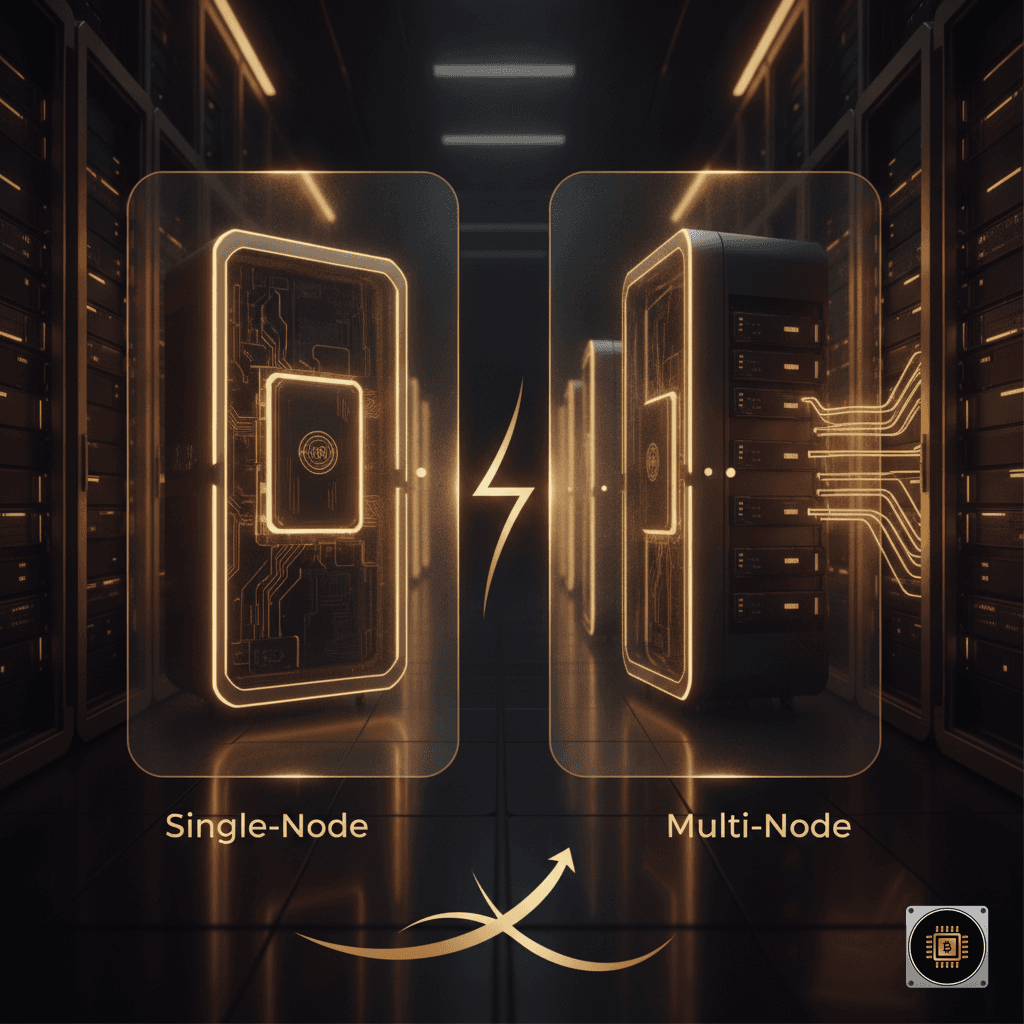
Deploying artificial intelligence, large language models (LLMs), and high-performance computing (HPC) workloads requires precise infrastructure planning. As machine learning models grow from billions to hundreds of billions of parameters, engineering and procurement teams face a fundamental hardware decision: scale up within a single system or scale out across multiple chassis. Choosing between a single node vs multi node GPU cluster impacts not only training velocity and batch sizing but also network topology, operational complexity, and total cost of ownership (TCO). Understanding the architectural tradeoffs between scale-up and scale-out GPU systems is essential for building efficient, reliable enterprise compute environments.
Understanding Single-Node Architecture (Scale-Up)
A single-node GPU configuration consists of an individual server chassis housing multiple GPUs connected directly to host CPUs and system memory over PCIe buses or high-bandwidth interconnects like NVLink. In a single-node deployment, all accelerator cards share host hardware resources, including power delivery, cooling systems, system RAM, and NVMe storage pools.
Key Advantages of Single-Node Infrastructure
- Minimal Communication Overhead: GPUs within a single node communicate over direct high-bandwidth links or local PCIe switches. NVLink fabrics inside a server deliver ultra-low latency and multi-terabyte-per-second bandwidth, bypassing external networking layers entirely.
- Simplified Software Stack: Engineering teams avoid the operational friction of distributed training frameworks like Message Passing Interface (MPI) or multi-node Kubernetes clusters. Standard frameworks like PyTorch natively handle single-node multi-GPU distribution with minimal setup.
- Lower Infrastructure Complexity: Single-node servers do not demand specialized high-speed fabrics such as InfiniBand or RDMA over Converged Ethernet (RoCE v2) switches, significantly lowering procurement and network administration costs.
Hardware Bottlenecks and Limits
Despite its simplicity, single-node infrastructure encounters physical boundaries:
- Memory Capacity Ceiling: Total system VRAM and HBM memory are constrained by how many GPUs a single chassis can physically hold and supply with power. When a model's state, gradients, and optimizer memory exceed available local memory, single-node scaling hits a hard limit.
- Thermal and Power Densities: Modern enterprise servers housing eight dual-slot or SXM-based accelerators pull substantial power from a single rack, creating intense thermal management challenges for standard data center environments. Enterprise systems such as the Supermicro AS-4125GS GPU Server are engineered to maximize single-chassis density while maintaining optimized airflow and thermal headroom.
Understanding Multi-Node GPU Architecture (Scale-Out)
Multi-node GPU clusters distribute compute tasks across multiple distinct server chassis connected over specialized high-speed networks. In scale-out systems, node-to-node communication relies on Remote Direct Memory Access (RDMA) to bypass host CPU overhead and move data straight between GPU memories across nodes.
Key Advantages of Multi-Node Infrastructure
- Linear Scalability: Multi-node clusters allow organizations to scale compute capacity and memory pools horizontally. By adding nodes, infrastructure teams can aggregate thousands of GPU cores and petabytes of aggregate VRAM.
- Unlocked Model Parallelism: Massive models like 70B+ parameter LLMs require multi-dimensional parallelism (combining tensor, pipeline, and data parallelism). Scale-out architectures provide the aggregate HBM required to distribute model parameters across tens or hundreds of cards.
- Fault Tolerance and Resiliency: Distributed training clusters can survive individual node hardware failures through dynamic task reassignment and distributed checkpointing, protecting lengthy training runs from complete failure.
Challenges of Distributed Infrastructure
- Network Bottlenecks: Inter-node data transfers over physical Ethernet or InfiniBand networks are orders of magnitude slower than intra-node NVLink speeds. Without proper network provisioning, GPUs spend idle time waiting for gradient synchronization.
- Operational and Software Complexity: Managing scale-out clusters requires orchestrators like Slurm or Kubernetes with specialized operators, precise RDMA tuning, and distributed file systems to feed high-throughput training data continuously. Deploying enterprise-grade accelerators like the NVIDIA H100 80GB or NVIDIA H200 across nodes requires carefully designed non-blocking network fabrics.
Key Differences: Single Node vs Multi Node GPU Cluster Workloads
Choosing the right architecture requires mapping model size, dataset volume, and operational maturity against resource requirements.
- Data Parallelism vs Model Parallelism: If a model fits completely within the local memory of a single node's GPUs, data-parallel training across that single server provides maximum compute throughput without inter-node delays. However, when a model exceeds single-node memory capacity, splitting model layers or tensors across a multi-node cluster becomes mandatory.
- Interconnect Latency: Single-node systems utilize local board-level interconnects running at up to 900 GB/s or higher per card, whereas multi-node interconnects rely on 200Gb/s to 800Gb/s network interface cards (NICs).
- Storage Throughput: Multi-node environments require centralized distributed NVMe storage solutions to ensure high-performance IOPS across all computing nodes simultaneously, whereas a single node can rely on local high-speed host drives.
To scale infrastructure efficiently, enterprise teams frequently balance high-density single nodes with scalable network fabrics available across specialized enterprise AI servers.
When to Scale Out to Multi-Node Infrastructure
Transitioning from a single node to a distributed cluster represents a major operational shift. Organizations should evaluate scaling out when encountering specific operational thresholds:
- Model Capacity Exceeded: When state-of-the-art model training causes Out-Of-Memory (OOM) errors despite memory-saving techniques like activation checkpointing, flash attention, and 8-bit quantization.
- Execution Time Limits: When single-node training iteration times extend into weeks or months, delaying production deployments and AI engineering iteration cycles.
- High-Concurrency Multi-Tenancy: When enterprise research teams share infrastructure and require simultaneous execution of multiple large-scale fine-tuning or inference jobs.
Strategic Recommendations for Compute Procurement
For most mid-sized enterprises, AI startups, and research teams, starting with high-density, scale-up single nodes provides the fastest route to production with minimal technical debt. As workload demands scale, connecting these nodes with high-bandwidth RDMA networks builds a resilient scale-out foundation.
When selecting a single node vs multi node GPU cluster setup, evaluate present workload demands while engineering network topologies that support future scale-out expansions.
FAQ
What is the main network requirement for a multi-node GPU cluster? Multi-node GPU clusters require low-latency, high-bandwidth interconnects with support for RDMA, such as InfiniBand or RoCE v2 Ethernet. This allows network interfaces to transfer data directly between GPU memories on different nodes without involving host CPU memory, minimizing synchronization delays.
Can I train large language models on a single node? Yes, small to medium-sized LLMs (such as 7B to 13B parameter models) can be trained or fine-tuned on a single node equipped with multiple high-VRAM enterprise GPUs using quantization and memory-efficient parallel training techniques.
How does NVLink differ from RDMA in GPU clusters? NVLink is an ultra-high-speed, intra-node interconnect designed to link GPUs within the same server chassis at massive bandwidths. RDMA is an inter-node networking technology that enables direct GPU-to-GPU memory access across separate physical server nodes over external network fabrics.
Which option offers a lower total cost of ownership (TCO)? Single-node systems offer a lower TCO for smaller workloads because they avoid expensive high-speed switch fabrics, enterprise management software, and complex network infrastructure. However, for large-scale enterprise AI workloads, multi-node clusters offer higher cost efficiency by completing massive training jobs in a fraction of the time.

CryptoMine Editorial
Hardware specialists at CryptoMine — helping businesses choose, configure and deploy AI servers, data-center GPUs and workstation hardware.